How Many Stamps for a Reward?
You are setting up a stamp card and wondering: how many stamps until the reward? 8? 10? 15? The answer: it depends on your industry, your margin and your customers' visit frequency. This guide shows you the optimal number for every industry – with concrete examples and a simple formula.
TL;DR
The rule of thumb: 8–12 stamps for most industries. Cafés → 10 Stempel, Friseure → 5, Restaurants → 8, Fitness → 10. Die Belohnung sollte 8–15 % des generierten Umsatzes wert sein.
Too many stamps and customers lose motivation. Too few and you give away margin. Find the sweet spot here.
The short answer
The rule of thumb: 8–12 stamps for most industries
Why exactly this range? Because it hits the sweet spot between customer motivation and economic viability.
Customer loyalty studies show: the closer a customer is to their goal, the more frequently they return. This is called the "Goal-Gradient Effect" – and it only works when the goal feels achievable.Je näher ein Kunde seinem Ziel ist, desto häufiger kommt er. Das nennt sich "Goal-Gradient-Effekt" – und er funktioniert nur, wenn das Ziel erreichbar wirkt.
Bei weniger als 5 Stempeln kommt die Belohnung zu schnell. Das klingt erstmal gut, aber: Der Kunde hat keinen Grund, regelmäßig wiederzukommen, und deine Marge leidet. Bei mehr als 12 Stempeln passiert das Gegenteil: Kunden geben auf, weil das Ziel zu weit weg liegt.
8–12 stamps is the range where customers stay motivated and you still make money. But the exact number within this range? That depends on three factors.
Industry
A café has different visit rhythms than a hairdresser. The number of stamps must match customer behaviour.
Margin
The higher your margin, the more generous the reward can be. The lower it is, the more stamps you need.
Visit frequency
Daily customers can handle 10 stamps. Monthly customers need fewer, otherwise it takes too long.
Industry comparison
Recommended number of stamps by industry
Every industry has its own visit rhythms. Here are the recommendations at a glance.
Faustregel: Rule of thumb: The reward should be achievable within 3–6 weeks. If it takes longer, customers lose interest. If it's faster, you're giving away margin.
The margin decides: How to calculate
The number of stamps is not an arbitrary number – it is an economic decision. The formula is simple:
The formula
Reward cost ÷ (number of stamps × avg. revenue per visit) = reward ratio
Ziel: Die Belohnungsquote sollte zwischen 8 % und 15 % liegen.
Example: Café
- Avg. revenue per visit: €4.50
- Number of stamps: 10
- Reward: Free coffee (retail value €3.50)
- Total revenue: 10 × €4.50 = €45
- Reward ratio: 3.50 / 45 = 7.8%
Result: Perfectly within range.
Example: Hairdresser
- Avg. revenue per visit: €35
- Number of stamps: 5
- Reward: Free haircut (retail value €25)
- Total revenue: 5 × €35 = €175
- Reward ratio: 25 / 175 = 14.3%
Result: At the upper end, but sustainable thanks to high margin.
Tipp: If your reward ratio exceeds 15%, increase the number of stamps or offer a less expensive reward. Below 8%? Then you can afford a more generous reward – this increases your customers' motivation.
Consider visit frequency: When is the reward achievable?
The number of stamps alone says nothing – what matters is how long it takes a customer to collect them. 3 to 6 weeks is the ideal timeframe.
Why? Because the Goal-Gradient Effect is strongest within this period. The customer feels progress and comes more often. After 6 weeks without a reward, motivation fades.
High frequency (daily)
Café, bakery, canteen
8–12 stamps
2–4 weeks to reward
Medium frequency (weekly)
Restaurant, ice cream parlour, juice bar
6–10 stamps
3–6 weeks to reward
Low frequency (monthly)
Hairdresser, nail salon, car wash
5–6 stamps
3–6 months to reward
Sonderfall monatliche Besuche: Special case – monthly visits: For industries like hairdressers or nail salons, it naturally takes longer to fill the card. The absolute number matters less here – what matters is that the reward is correspondingly valuable. A free haircut after 5 visits feels fair, even if it takes 5 months.
What to offer as a reward?
The reward is just as important as the number of stamps. A poor reward ruins even the best stamp card. Here are the options, sorted by effectiveness:
Free product (bestseller)
Beispiel: Free coffee, free haircut, free pizza
Highest motivation. Customers know the value and find it fair.
Free add-on product
Beispiel: Free dessert, free drink with meal, free styling
Very good. Lower cost for you, yet still valuable for the customer.
Percentage discount
Beispiel: 20% off the next purchase
Works, but feels less tangible than a concrete product.
Fixed euro discount
Beispiel: €5 off the next visit
Easy to understand, but can feel demotivating at low amounts.
The psychological trick: Concrete beats abstract
"A free coffee" feels stronger than "€2 off" – even if the retail value can be identical. The reason: a concrete product is tangible, imaginable and feels like a real gift. A discount is just a number.
Avoid
6 common mistakes with stamp counts
These mistakes come up again and again – and they cost you either customers or margin.
Too many stamps (15+)
Customers lose motivation when the goal seems unreachable. After 12 stamps, the completion rate drops drastically.
Stick to 5–12 stamps depending on the industry.
Too few stamps (3 or fewer)
The reward comes too quickly and eats into your margin. There is also no incentive to keep coming back regularly.
At least 5 stamps to build genuine customer loyalty.
Reward too small
A "10% discount" after 10 stamps doesn't feel rewarding. Customers want something tangible.
Offer a concrete free product – it feels more valuable than a percentage discount.
Reward too large
A complete free meal after 5 visits can blow your margin.
Calculate in advance: reward costs should not exceed 8–15% of generated revenue.
No visible progress
With paper stamp cards, customers forget how far along they are. With lost cards, they start from zero.
A digital stamp card always shows progress – and is never lost.
Rules too complicated
"Only Monday to Wednesday, from €10 purchase value, not combinable with..." – customers drop out.
Keep it simple: 1 visit = 1 stamp. Done.
What it looks like in practice
Stamp count and reward – configurable directly in the dashboard
Number of stamps, type of reward, welcome stamp – all configured in under 2 minutes.
1.281
Gesamtkunden
6.316
Gesamtstempel
3.114
Eingelöste Belohnungen
Live
Stempel heute
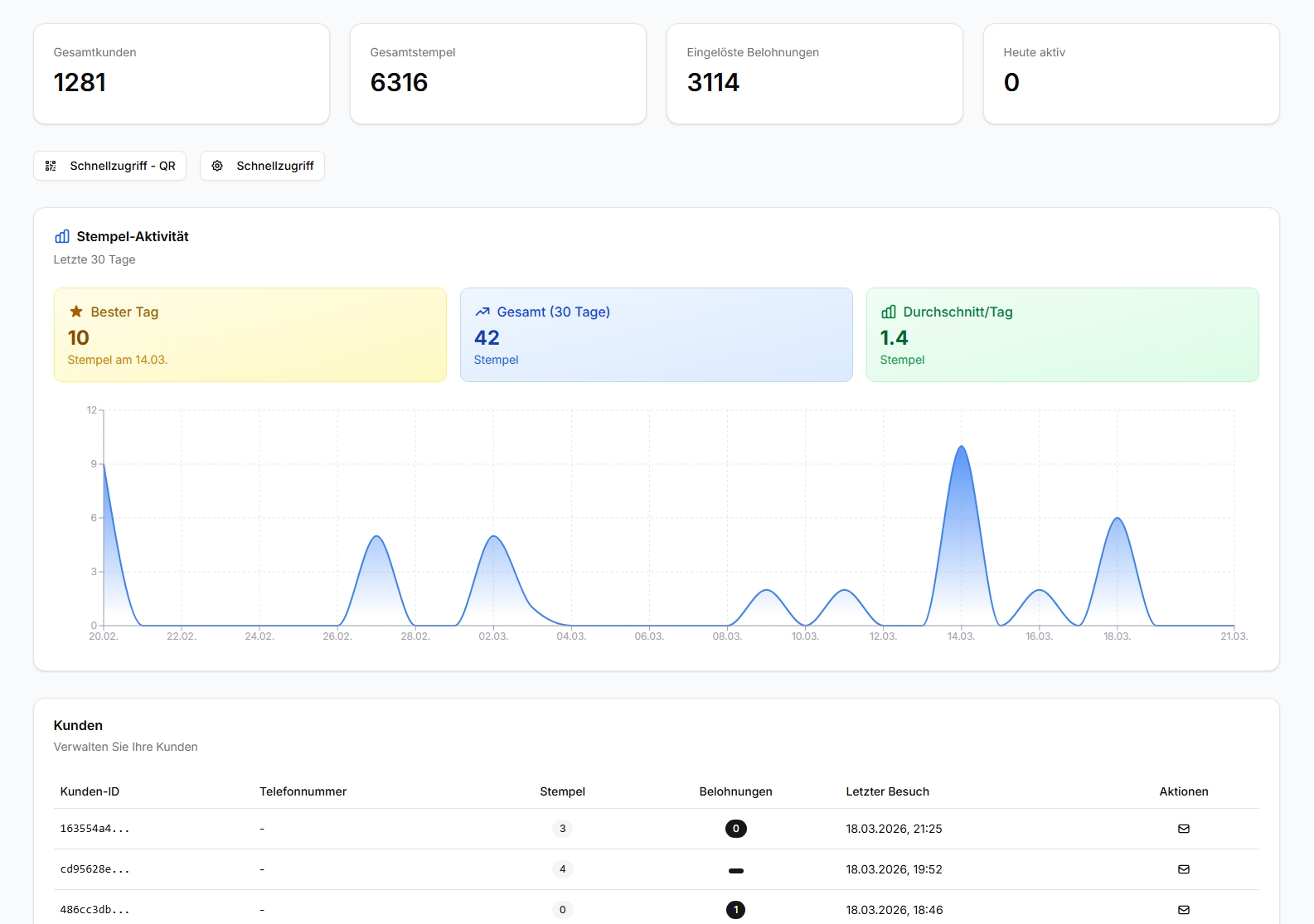
Real production data. Stamp count, reward and all settings changeable at any time.
Choose your plan
Start free and upgrade as your business grows.
Basic
- Up to 50 stamp cards
- Digital loyalty card
- QR code scanner
- Basic statistics
- Customer management
- Configurable stamp card
- Contactless stamps (NFC)
- Send offers & reminders
Business
- Unlimited stamp cards
- All Basic features
- QR code with logo
- Advanced statistics
- CSV export
- Automatic reminders
- Contactless stamps (NFC)
- Send offers & reminders
Premium
- All Business features
- Contactless stamps (NFC)
- 2x NFC tags included
- Send offers & reminders
- Multi-location
- Multiple stamp cards
- Priority support
- Custom app
Enterprise
On request
- Custom app with your branding
- Custom logo & design
- Custom logic & workflows
- Unlimited locations
- Dedicated account manager
- Custom integrations
- Everything from Premium
- Unlimited scalability
All prices exclude applicable VAT.
8 häufige Fragen: Stempelanzahl & Belohnung
How many stamps should a stamp card have?
The rule of thumb is 8 to 12 stamps. The exact number depends on your industry, your margin and your customers' visit frequency. A café with daily customers chooses 10 stamps, a hairdresser with monthly visits more like 5.
Are 10 stamps too many for a stamp card?
Not with frequent visits. When customers come 3–5 times per week (e.g. café, bakery), 10 stamps are achievable in 2–3 weeks. With infrequent visits (e.g. hairdresser, restaurant), 10 stamps would be too many – 5–8 are recommended there.
What is the best reward for a stamp card?
The most popular reward is a free product: a free coffee, a free haircut, a free dessert. Discounts (e.g. 20% off the next purchase) also work, but feel less valuable. The perceived value of the reward should correspond to 8–15% of the revenue the customer generates.
Can I change the stamp count later?
With Stempely, yes – you can adjust the number of stamps required at any time in the dashboard. Customers who have already collected stamps keep their progress. This way you can experiment and find the optimal number.
How do I calculate the cost of a stamp card reward?
Calculate like this: if a customer spends €5 per visit and needs 10 stamps for a free coffee (retail value €3), you invest €3 to generate €50 in revenue. That's 6% reward costs – very profitable for most industries.
Should I give a bonus stamp at the start?
Yes, this is a proven strategy. Research shows that customers with a "head start" are more motivated to complete the card (Goal-Gradient Effect). With Stempely you can automatically award a welcome stamp.
How many stamp cards does the average customer have?
Studies show that customers use an average of 3–5 active loyalty programmes. With a digital stamp card in the app, the barrier is lower: no extra card, no wallet chaos. This significantly increases the usage rate compared to paper stamp cards.
What does a digital stamp card with Stempely cost?
Stempely offers a permanently free plan with one stamp card and up to 50 customers. The Business plan for €5/month includes unlimited stamp cards, unlimited customers, push notifications and statistics. No contract, cancellable monthly.
"We used to have 15 stamps on the paper card – nobody ever filled it up. With Stempely and 8 stamps, people actually come back."
— L. W., Restaurant Owner, Berlin
Your stamp card. Your rules. Live in 5 minutes.
Choose your stamp count, define the reward and get started today. Changes possible at any time – no contract, no risk.
Business plan: €5/month · Free plan available · Cancel monthly
Start now — no contract, no credit cardPermanently free · GDPR-compliant · Servers in Germany